This archive showcases expandable and annotated images of all known photographs of Oscar Wilde taken by Napoleon Sarony in New York City. Twenty-nine are known from 1882 and three from 1883. For a note on the number see Introduction.
All images are in the public domain, but fair use requires the courtesy of citing this archive in any reproduction.
Reproduction of image 3A requires the permission of the Harry Ransom Center, The University of Texas.
All text and research is © John Cooper on Oscar Wilde.
Additional dress notes provided by Rachel Klingberg, The New York Nineteenth Century Society.
Thanks are due to Geoff Dibb & Merlin Holland (The Oscar Wilde Society) for their corroboration of Wilde’s two fur coats, and to Eric Colleary, PhD, Cline Curator of Theatre and Performing Arts, and Cristina Meisner, Research Associate III at the Harry Ransom Center, The University of Texas at Austin in relation to photograph 3A.


Number 1
Perhaps with this iconic head shot in mind Sarony said on meeting Wilde: “A picturesque subject indeed!”
This example is rare with Sarony’s signature mount.
Number 2
Notated as No.2 but probably taken at the same time as numbers 6· to 9.
See below under Repeating Back.
Number 3
Reporters who met Wilde off the boat described him with a sealskin cap perched on his head several sizes too small for him.
See counterpart 3A.
Number 3A
This three-quarter shot with hat removed was identified as a Sarony variant relatively recently in the Harry Ransom Center, The University of Texas at Austin.


Number 4
The only photograph in which post-processing is evident with the intentional fading typical in cabinet cards.
Number 5
Wilde wore this fur coat for all of the pictures up to number 9. A close examination reveals that, although similar, it is curiously not the same fur coat that he wears in photographs 19-22.
Number 6
The trousers were brown, the necktie was sky blue and he carried a pair of kid gloves. Piped velvet doublet, turn-down collared shirt under the fur-trimmed coat.
Comparable to 2, 7 and 8.
Number 7
Some photographs are in pairs taken as Wilde held his pose, only slightly changing position.
Comparable to 2, 6 and 8.


Number 8
His shirt has a turn-down collar. Although now the norm, it was unusual for the era when detached band collars were common. Comparable to 2, 6 and 7 with the position of the coat adjusted.
Number 9A
One of two photographs with the inscribed number 9. Wilde is holding a copy of his Poems (1881).
See below under Fingers.
And Repeating Back.
Number 9B
A counterpart of 9A also with an inscribed number 9 except Wilde is not holding the book. Otherwise the pose is virtually (but not exactly) identical.
See below under Fingers.
Number 10
A counterpart of 11. Wilde has removed his coat and changed into his knee-breeches, silk stockings, and patent leather slippers to “be used in the drawing-room.” The bows were highly unconventional.


Number 11
A counterpart of 10, Wilde having moved only his right arm. See below under Repeating Back. The velvet doublet is similar to a sack coat trimmed with piping at the hem and ‘smile’ pocket.
Number 12
The item hanging below Wilde’s vest is a bunch of seals (used for sealing wax impressions). Wilde later said that waistcoats will show whether a man can admire poetry or not.
Number 13
Wilde changed his jacket and tie to complete his evening dress. On his right hand Wilde has a seal ring (used for sealing wax impressions).
From the Blog:
First Impression
Number 14
The double-breasted smoking jacket has frogged closures and satin quilted collar & cuffs. Worn to protect clothing from ash, smoking jackets also provided additional warmth in draughty Victorian homes.


Number 15
Reclining on what appears to be a pelt (but see Fur Rug below) with his feet on a Turkish carpet. The only photograph in landscape orientation, although it is sometimes seen cropped to portrait mode.
Number 16
The stockings are clocked (a woven process of decorating the fabric). Wilde wrote: “trousers become dirty in the street; knee-breeches are more comfortable…pretty to look at too…”
Number 17
Taken concurrently with 13. Towards the end of Wilde’s tour a newspaper quipped: “Oscar Wilde’s photographs are being displaced in shop windows by the less effeminate Mrs Langtry’s”.
Number 18
Plagiarized for a trade card, leading to a famous case in the Supreme Court that established the law of copyright for photographs.
From the Blog:


Number 19
Wilde wrote to D’Oyly Carte in March 1882 to suggest a lithograph of him would help business: “The photograph of me with head looking over my shoulder would be the best - just the head and fur collar.”
Number 20
Wilde wrote: “Great success here: nothing like it since Dickens, they tell me. I am torn in bits by Society…crowds wait for my carriage. I wave a gloved hand and an ivory cane and they cheer.”
Number 21
Wilde’s mother wrote to Oscar: “The photographs are greatly admired here - especially the standing figure in the fur coat - they are beautifully executed. I only object to the hair parted in the centre.”
Number 22
The seal ring has now moved to his left hand: either an artistic move by Sarony; or as part of Wilde’s First Impression. Note the tear in the chair’s upholstery.

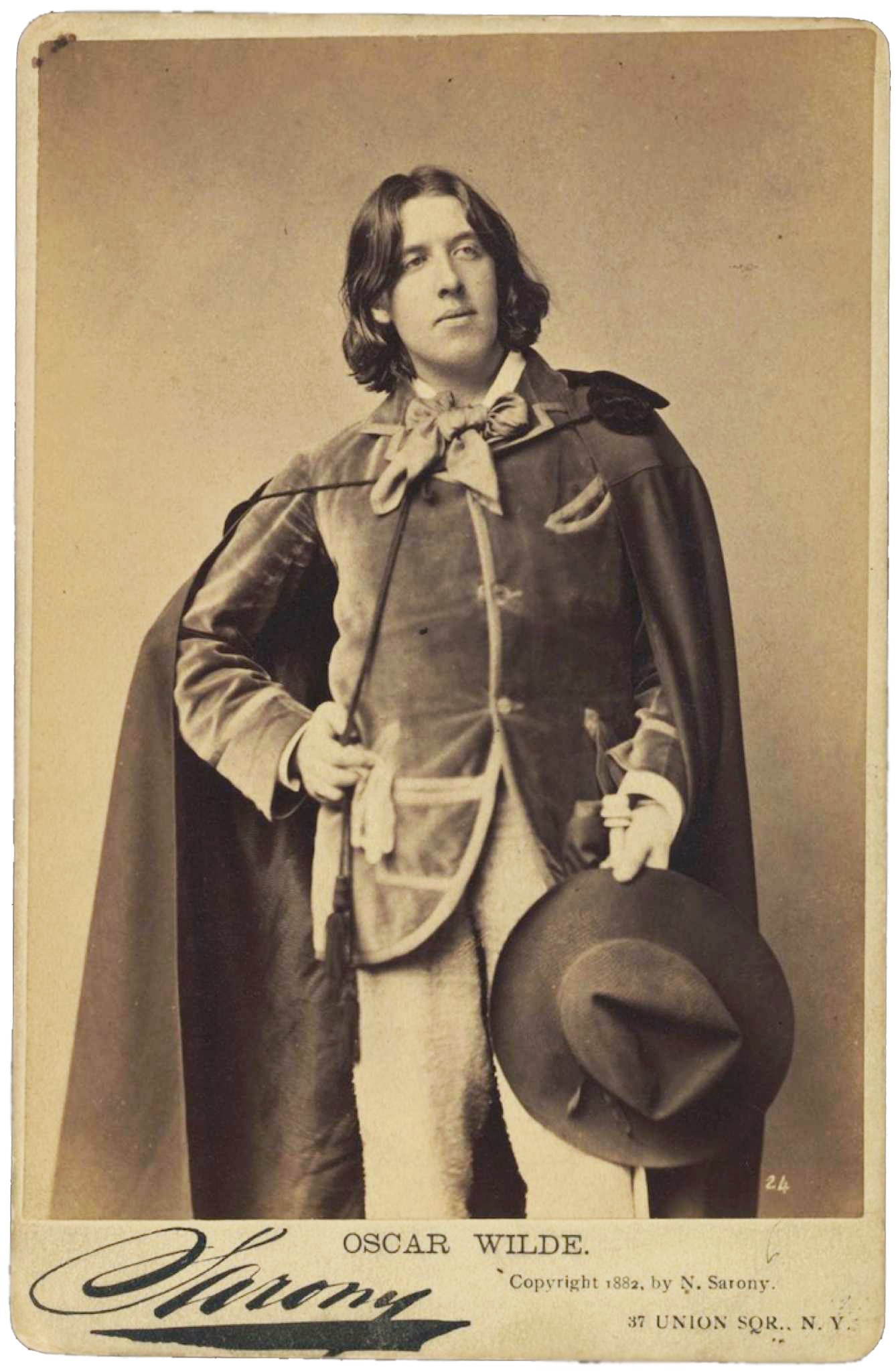


Number 23
This is the photograph used as the cover to Richard Ellmann’s notable biography Oscar Wilde (1997).
Number 24
Based on Wilde’s longer hair and different garments, the last 4 photographs (24-27) seem certain to have been taken at a later date.
Number 25
Wilde wrote: “The large hat of the last century was sensible and useful, and nothing is more graceful in the world than a broad-brimmed hat…” Similar to the US “wide-awake” hat.
Number 26
Wilde thought garments should be hung from the shoulders, their natural support (not tight waists), and that capes afforded the oblique line that conveys the impression of dignity and freedom.


Number 27
Wilde wrote: “We have lost the art of draping the human form and the cloak is the simplest and most beautiful drapery ever devised.'
1883-A
The first of three known photographs from late Summer of 1883 when Wilde revisited America. He had his hair cut short in the Spring of that year in Paris in homage to a bust of Nero in the Louvre.
1883-B
The second of three known photographs from late Summer of 1883 when Wilde revisited America. He had his hair cut short in the Spring of that year in Paris.
See Nero below.
1883-C
The third of three known photographs from late Summer of 1883 when Wilde revisited America. He had his hair cut short in the Spring of that year in Paris, and here he is in Summer attire.


Poems
This is the book Wilde holds in several photographs. It is is his self-published Poems (1881).
Numbers
The numbering of the Sarony photographs is made possible by the inscribed numbers on the negatives (white) or on prints (black). Not all examples of prints have numbers, but most in this gallery do.
Fingers 9A
There are two number 9s. The inscribed numeral 9 in each is different, and in one Wilde is holding a copy of his Poems (1881). Otherwise the two photographs are virtually identical.
Fingers 9B
Ignoring print imperfections, and apart from losing the book, the only visible differences between 9A and 9B are the slightly altered position of Wilde’s fingers, and amount of cuff exposed.


The Last Four
A rare negative positive, and one of the last four, which, based on Wilde’s longer hair and different garments, was taken at a later date in 1882.
See The Last Four.
Nero I
Wilde’s short hair in 1883 was inspired by a bust of Nero in the Louvre. For the last word on this subject see Rob Marland, “Imitatio Neronis”, The Wildean No. 5, July 2021 (Oscar Wilde Society).
Nero II
Not a Sarony picture but is this this complete Nero look?
By Robert W. Thrupp, Birmingham, 1884.
Repeating Back
Sarony’s camera probably had a draw-slide attachment to expose two halves of a single plate. This technique accounts for the pairs of images in which Wilde held his pose between successive exposures.

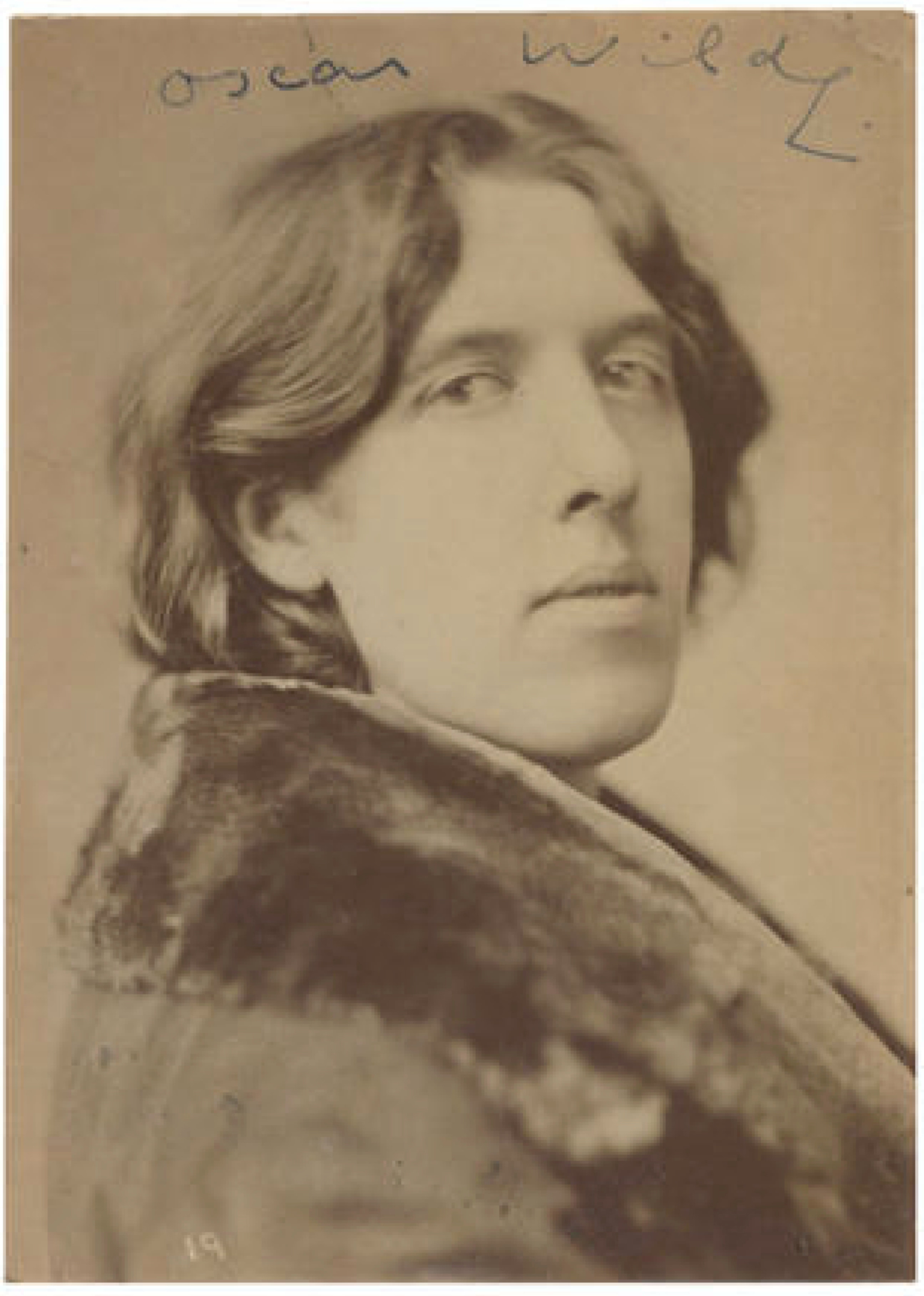


Oscar, Sarah, and Lillie
Oscar standing in exactly the same place in the Sarony’s studio in which Sarah Bernhardt had stood earlier in 1880, and Lillie Langtry later in 1882.
See Blog: Same Difference.
Number 19 Retouched
Despite differences in the collar, the hair on one side, and the inscribed number, this variant of number 19 is a actually retouched version of the one shown above.
See Blog: Beckwith
Two Fur Coats
The coat in 1-9 has a fur lining, frogging & toggles, and notched collar. The coat in 20-23 has none of these, and a silk edging. It may be the dress coat seen in this 1881 photograph.
Fur Rug
This clipping (Hartford Courant) says that Wilde carried with a fur rug, and if so, this may be what he is reclining on. It might, however, simply be his heavily fur lined coat, that the report mistook for a rug.

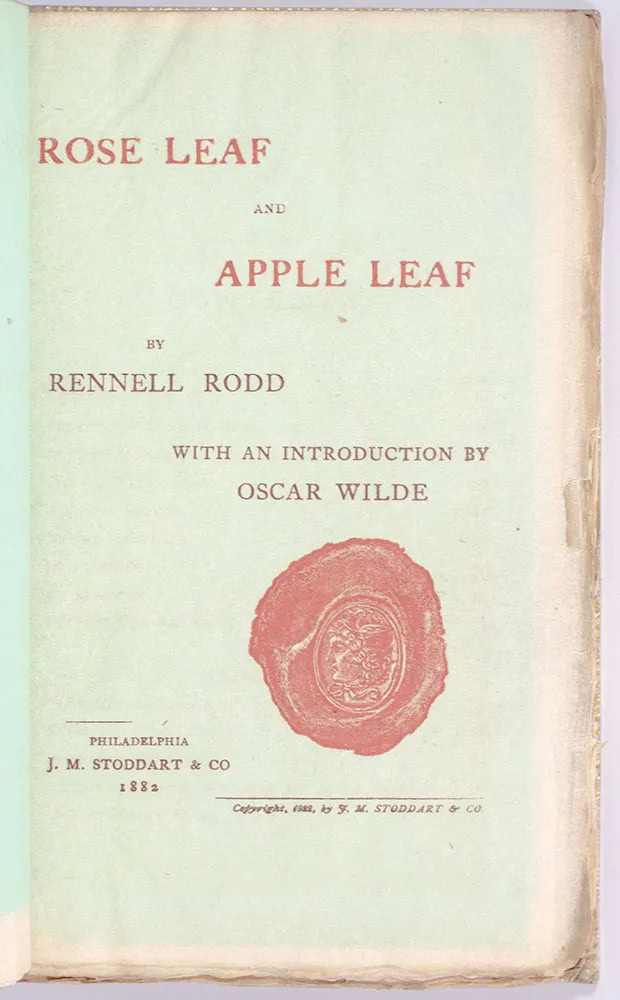


Wilde’s Signet Ring
Oscar wears a signet ring, used for impressing sealing wax, on his right hand, e.g. in No. 9. It moves to his left hand in No. 22 perhaps to better suit the pose.
Signet Ring Reused
Wilde reuses the signet ring of Mercury as artistic emblem on the title page of Rose Leaf and Apple Leaf, a book he arranged to be produced for his friend Rennell Rodd.
Lost and Found
“Oscar Wilde’s solid ivory cane arrived by express Saturday. he left it at Central City, Col., and it is following him up.”
The Daily Bee (Omaha, NE) May 1, 1882,
1 by 1
Two versions of Sarony No. 1—the famous iconic headshot of Wilde. The one on the right is the more familiar, but they do not quite look the same.